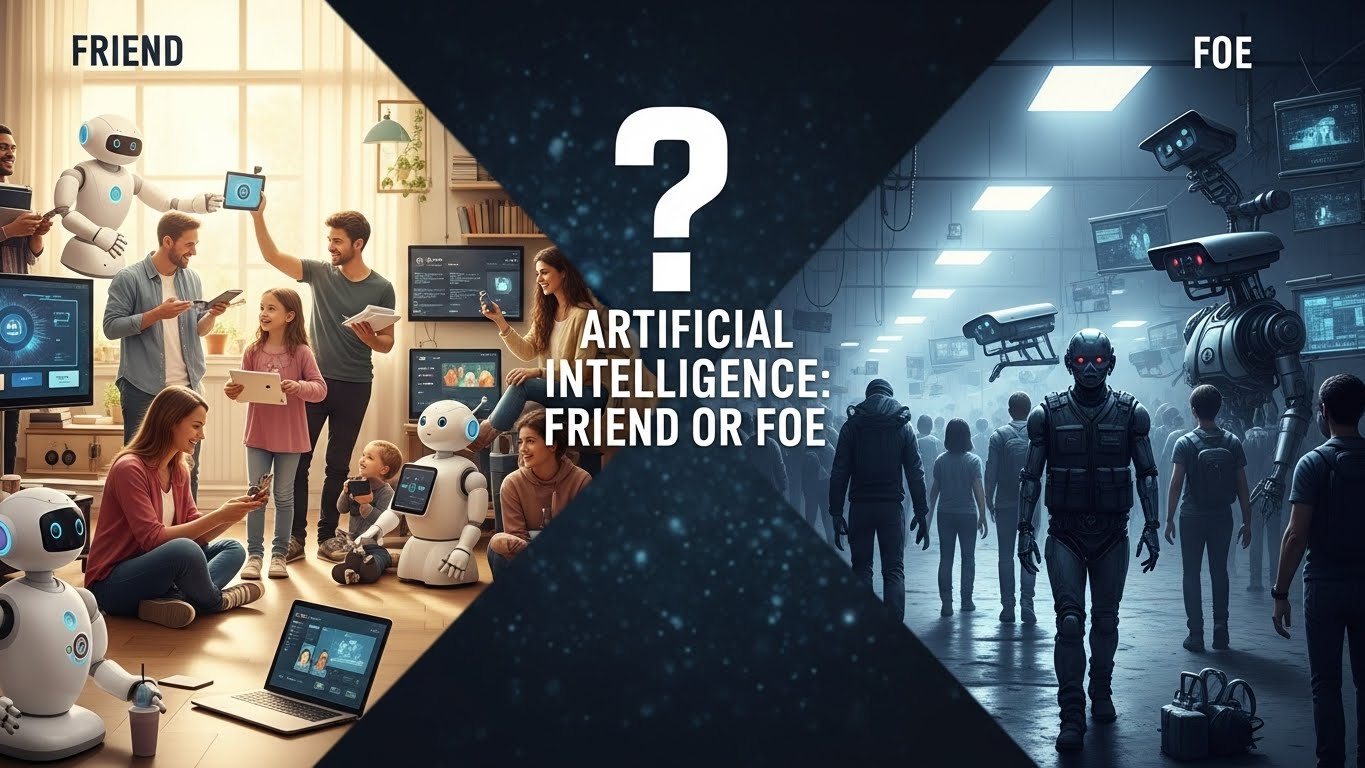
Artificial Intelligence: Friend or Foe?
Artificial Intelligence has quietly become one of the most influential forces of the modern age. It helps us navigate cities, recommends what we watch, assists doctors in diagnosis, and even writes text that feels human. Yet despite its convenience and power, many people remain uneasy about its rapid growth. Is artificial intelligence truly our greatest ally, or does it pose a hidden threat to our future? The answer, as with most powerful technologies, lies somewhere in between.
To many, AI is a helpful friend. It simplifies daily life in ways that were once unimaginable. Smartphones unlock with a glance, virtual assistants answer questions instantly, and online platforms suggest music, movies, and products tailored to personal tastes. These experiences feel normal now, but they rely on complex algorithms processing enormous amounts of data in the background. AI saves time, increases comfort, and offers personalized experiences that make modern life smoother and more efficient.
In the workplace, artificial intelligence has become a valuable partner. Businesses use AI to analyze consumer behavior, manage inventory, detect fraud, and automate repetitive tasks. In factories, smart robots perform precise operations with speed and consistency. In offices, intelligent software processes documents, schedules meetings, and handles customer inquiries. This allows workers to focus on creative thinking, strategy, and problem-solving rather than routine labor. When used wisely, AI boosts productivity and helps businesses grow in competitive markets.
Healthcare is another area where AI shows its most promising potential. Intelligent systems analyze medical images, detect early signs of disease, and assist doctors in making faster and more accurate diagnoses. AI-powered tools help predict patient risks, personalize treatments, and improve hospital efficiency. For patients, this can mean earlier detection, better care, and even saved lives. In this sense, artificial intelligence appears as a life-saving friend advancing the limits of modern medicine.
Education, too, is being reshaped by artificial intelligence. Adaptive learning platforms adjust content according to each student’s pace and ability. Virtual tutors provide support at any time, breaking the boundaries of traditional classrooms. Students in remote or disadvantaged regions can access high-quality educational resources that were once out of reach. AI has the potential to make learning more inclusive, flexible, and personalized than ever before.
Yet alongside these benefits comes a growing sense of fear. As intelligent machines take on more tasks, concerns about job displacement intensify. Many fear that automation will replace human workers, especially in industries dependent on routine or manual labor. While history shows that technology often creates new jobs as it eliminates old ones, the speed of change with AI feels unprecedented. Workers are under pressure to constantly reskill, and not everyone has equal access to education or training. This creates anxiety, inequality, and social tension.
Privacy is another major source of concern. AI systems rely heavily on data — personal data — to function effectively. Every click, search, location, and online interaction becomes part of massive datasets used to train algorithms. This raises difficult questions: Who owns this data? How securely is it stored? And who has the right to use it? In a world increasingly driven by surveillance technologies, the line between convenience and intrusion grows dangerously thin.
Bias and fairness also challenge the idea of AI as a trusted friend. Algorithms learn from human-generated data, and if that data contains prejudice, the system may reproduce or even amplify it. Decisions made by AI in hiring, lending, policing, or immigration can deeply affect people’s lives. When these decisions are hidden behind complex code, accountability becomes difficult. A machine may appear objective, but its outcomes often reflect human flaws embedded in the data.
Perhaps the most alarming fears surround the misuse of artificial intelligence. Deepfake videos, automated misinformation, cyberattacks, and AI-powered weapons reveal how easily the same technology that benefits society can also be turned into a tool of harm. The ability to manipulate reality at scale threatens trust, democracy, and global security. As machines become more autonomous, the question of human control becomes increasingly urgent.
So, is artificial intelligence a friend or a foe? The truth is that AI itself is neither good nor evil. It is a tool — powerful, neutral, and shaped entirely by human intention. In the hands of responsible developers, ethical governments, and informed users, AI can become one of the greatest instruments of human progress. In the wrong hands, or without proper regulation, it can deepen inequality, weaken privacy, and amplify global risks.
The real challenge lies not in the technology itself, but in how humanity chooses to guide its development. Ethical frameworks, transparent algorithms, education, and international cooperation are essential if we want AI to serve the common good. Society must remain actively involved in shaping the rules that govern intelligent machines, rather than surrendering decision-making entirely to them.
In the end, artificial intelligence reflects our own values, fears, and ambitions. It mirrors both our creativity and our mistakes. Whether AI becomes our trusted friend or our greatest foe will depend on the choices we make today. The future of artificial intelligence is, ultimately, the future of humanity itself.